
Decretum Gelasianum[1]
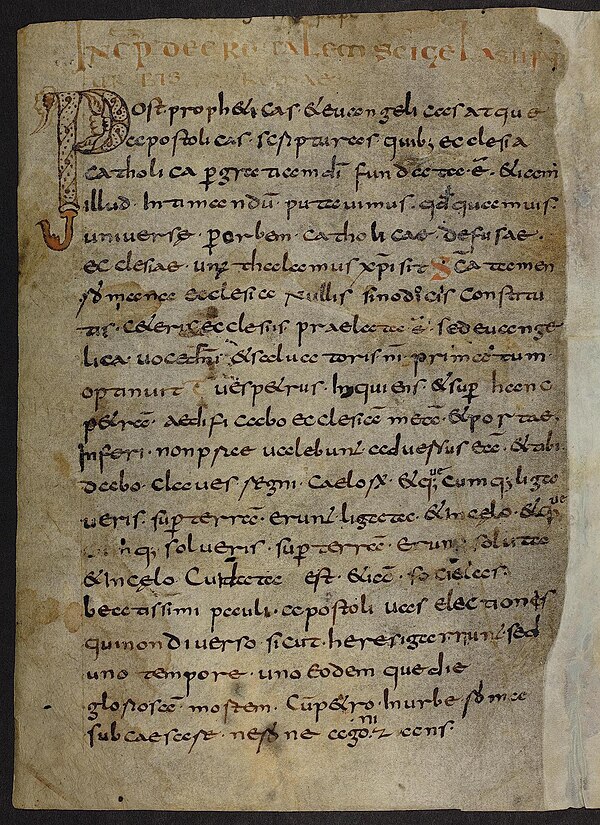
Yukarıdaki imaj, geleneksel olarak MS 496'ya tarihlenen buyrultunun bugüne ulaşan sayfalarından biridir. Sonlara doğru Aykırı Kitaplar başlığı altında okunması men edilenlerden biri de Barnabas İncili'dir. Yasaklanan kitap ve anlatılar için buyrultunun sonunda şöyle yazılmaktadır: "Bunları, sadece reddetmekle yetinmeyerek, Roma Katolik Kilisesi'nden tamamen ayırıyor ve uzaklaştırıyoruz; öyle ki yazarları ve takipçileri dönüşü olmayan aforoz bağıyla sonsuza dek lanetli olsun."
Liste kaç yaşında?
Listenin bir adı var, tarihi yok. Nüshaların çoğu onun Roma'da Papa Gelasius ile yetmiş piskopos tarafından yazıldığını söyler; Gelasius 492'den 496'ya kadar papaydı. Sekizinci ve dokuzuncu yüzyıldan dört nüsha, ilk üç bölümü bir asır önce Papa Damasus'un başkanlığında toplanan bir Roma meclisine verir. İspanyol geleneğindeki bir şekil ise Papa Hormisdas'ın (514–523) adını anar. Barnabas kaydı beşinci bölümdedir. Damasus'un adını taşıyan nüshalar üçüncü bölümde biter; Gelasius'u anan başlık ise beşinci bölüm de içinde olmak üzere son üç bölümün üstünde durur. Bugüne ulaşan en eski nüsha 700 dolaylarında yazılmıştır ve eseri kullandığı bilinen ilk yazar Sevillalı Isidorus'tur.[2]
Gelasius'un kendi devrinden yana üç şey konuşur. Nüshalar onun adını taşır ve onu anan başlık, Barnabas kaydı da içinde olmak üzere son üç bölümün üstünde durur. Listenin adını verdiği son sapkınlar Konstantinopolisli Akakios ile iki Petrus'tur; liste onlar için "biri İskenderiye'yi, öbürü Antakya'yı lekeleyen" der. Üçü de 488 ile 490 arasında öldü ve onlar hakkındaki kavga Gelasius'un papalığının bütün yılları boyunca sürdü. Gelasius Ağustos 494'te İlirya piskoposlarına yazdığı mektupta da aynı üç kişiden adlarıyla uzak durmalarını söyler. Üstelik yaygın kabule göre Gelasius, bu adamlar daha hayattayken papanın mektuplarını yazıyordu. Eski ve yeni başvuru kitapları onu 483'ten 492'ye kadar papa olan III. Felix'in kâtibi ve mektuplarını kaleme alan kişi olarak anar. Bunun arkasında iki şey vardır: Felix devrine ait, Temmuz 490 tarihli ve nüshaların Gelasius'a verdiği bir mektup ve bir üslup mukayesesi. Bu yaygın görüştür ve kesin değildir.[3]
John Chapman 1913'te son iki bölümün, yani kabul edilen yazılar ile reddedilen kitaplar listesinin, Gelasius'un ya da kâtiplerinden birinin eseri olduğunu savundu. Onun okumasına göre bu bölümler Damasus'un adıyla anılan daha eski Roma bölümlerine eklenmiş, bütün metin de 520 dolaylarında Hormisdas devrinde genişletilmişti.[4] Bu site listeyi aynı şekilde okur ve nüshalar buna bir gerekçe de verir. Nüshalar üç ad taşır ve üçü zaman sırasıyla durur: ilk bölümlerin üstünde Damasus, son üçünün üstünde Gelasius, sonraki bir İspanyol şeklinde Hormisdas. Kademe kademe büyümüş bir metin tam böyle görünür ve Barnabas kaydını taşıyan kademe Gelasius'unkidir. Bir ad ödünç alınabilir; listenin editörü de üç adın üçünün de ödünç olduğunu savundu. Araştırmacıların çoğu onu izler ve listeyi bir kuşak sonraya koyar; fakat bu, tek bir editörün okumasının izlenmesidir ve onun gerekçeleri bu bölümün sonunda duruyor. Bu sitenin okumasına göre Barnabas kaydı Gelasius'undur ve 492 ile 496 arasında yazılmıştır.
Listenin o yıllara bir bağı daha vardır ve bu bağ Kıbrıs'a çıkar. Listenin Antakya'ya bağladığı ikinci Petrus, o şehrin patriği Petrus Fullo'dur; bir Roma meclisi onu III. Felix devrinde mahkûm etmişti. Petrus son yıllarında Antakya'nın Kıbrıs kilisesini yönetme yolundaki eski iddiasını öne sürdü. Barnabas'ın mezarı hakkındaki anlatı da mezarın açılışını adanın ona verdiği cevap olarak sunar. En sağlam tarihe göre mezar 488'de açıldı; alışılmış hesaba göre Petrus da o yıl öldü.[5] Demek ki "Barnaba adıyla anılan İncil"i reddeden liste, mezarın cevap verdiği iddianın sahibi olan patriği de mahkûm eder.
Başlık da aynı yönü gösterir. Bu listeden önce hiçbir yazar Barnabas adıyla anılan bir İncil'in adını vermez. Listedeki komşu başlıkların ise daha eski kitaplara uzandığı bulunmuştur: Matthias ile Bartolomeus Origenes'e, Andreas da Papa I. Innocentius'un bir mektubuna. 405'te Roma'da yazılan o mektup Matthias, Küçük Yakup, Petrus, Yuhanna, Andreas ve Tomas adlarını taşıyan kitapları mahkûm eder; Barnabas aralarında yoktur. Bu listeden sonra başlık bir kez daha, yedinci yüzyıldan kalma Yunanca bir katalogda, Altmış Kitap Listesi'nde karşımıza çıkar.[6]
Innocentius'un mektubu ile bu liste arasında, bugüne ulaşan kaynaklar Barnabas'ın adının yanına bir İncil'i yalnızca tek bir yerde koyar: mezarının 488'de açıldığı Kıbrıs'ta. Oradan gelen haberin Roma'ya giden yolları vardı. 489'da bir elçi papanın talimatlarını İtalya'dan Zeno'nun sarayına götürdü; 490'da da Konstantinopolis'ten gelen keşişler yeni patriklerinin mektubunu Roma'ya getirdi. Böyle yolcuların anlatabileceği şey haberin kendisiydi: Barnabas'ın göğsünün üzerinde bulunan, onun kendi eliyle yazılmış ve bulanların Matta dediği bir İncil. Liste kitaplarını adlarıyla mahkûm eder; onu yapanın bu kitaplardan birini görmüş olması gerekmez. Fakat kararname Matta'ya göre İncil'i ikinci bölümünde kabul eder, bu başlığı ise beşinci bölümünde reddeder. Öyleyse kayıt o habere bir cevapsa, onu yazan kişi Barnabas'la birlikte bulunan kitabı Matta saymamıştı. Devrin hiçbir kaynağı kaydın o habere cevap olduğunu söylemez. Bu site kaydı böyle okur; o kitabın ne olduğu sorusunu da Barnabas'ın Mezarında Bulunan İncil sayfası ele alır.[7]
Tarihleri yan yana koyun. Barnabas'ın mezarı 488'de açıldı; o yıl papa III. Felix'ti ve yukarıdaki görüşe göre onun mektuplarını Gelasius yazıyordu. Bu sitenin okumasına göre kayıt mezardan dört ila sekiz yıl sonra gelir. Kayıtların verdiği her şey bu sayfadadır. Gelasius'un adı bölümün üstünde durur. Mahkûm edilen adamların listesi onun devrinin kavgasıyla biter ve Kıbrıs anlaşmazlığının patriği de onların arasındadır. Başlık da listelere ancak mezar açıldıktan sonra girer.
Liste hakkında öbür sorular
Liste Gelasius'tan sonra mı yazıldı? Listenin editörü 1912'de bunu savundu ve araştırmacıların çoğu onu izledi. Ernst von Dobschütz beş bölümün hepsini tek bir eser saydı; onu ne Damasus'un ne de Gelasius'un yayımladığını, İtalya'da yaşayan bir özel âlimin 519 ile 553 arasında yazdığını söyledi. Nüshalardaki kısa şekilleri, Gelasius'un adını taşıyan şekil de dahil, o tek eserin kısaltılmışları saydı. Eserin ilk bölümü Augustinus'un 416 dolaylarında yazdığı sözleri alıntılar; bu yüzden o bölüm Damasus'tan gelemez. Gelasius'un ölümünden kısa süre sonra Roma'da papalık kararlarını toplayan Dionysius Exiguus da eseri almaz; gerçi Gelasius'un mektuplarından yalnızca birini almıştır. Bu, listenin muhtevasına ve bir sessizliğe dayanan bir delildir. Arkasında tarihli bir belge yoktur; yine de el kitapları onun tarihini çoğu zaman bir kayıtmış gibi basar. Editörün kendi hesabına göre listedeki hiçbir şey 519'dan sonrasını göstermez ve o, listenin büyük ihtimalle o sıralarda, Papa Hormisdas devrinde yazıldığını düşünüyordu. Listenin en son mahkûm ettiği adamlar, 519'da ayrılığı bitiren formülde de adlarıyla anılır. 553 yılı ise yalnızca bir dış sınırdır; çünkü liste o yılki konsilin mahkûmiyetlerinden hiçbir iz taşımaz.[8]
Her başvuru kitabı onu izlemedi. William Jurgens 1970'te, kanonla ilgili bölümün 382 Roma meclisinden geldiğinin, Gelasius'un da eseri yeniden düzenleyip reddedilen kitaplar listesini eklediğinin artık yaygın olarak kabul edildiğini yazdı. The Oxford Dictionary of the Christian Church iki anlatımı da taşır: bir maddesi 382 listesinin 495'te Gelasius tarafından yeniden yayımlandığını söyler ("reproduced by Gelasius in 495"), kararname maddesi ise editörün görüşünü verir. Özel derleyiciyi bildiren New Catholic Encyclopedia de kararnameyi hâlâ muhtemelen farklı tarihlerden belgelerin bir araya getirilmesiyle oluşmuş sayar.[9] Liste Gelasius'unsa mezarın açılışından 4 ile 8 sene sonradır; editörün tarihine göre ise birkaç on yıl sonra. İki tarih de olaya yakındır ve ikisi de Hz. Muhammed'in (a.s.) doğumundan öncedir.
Bu başlık Barnabas Mektubu'nun başka bir adı olabilir mi? Mektup ayrı bir kitaptır ve asırlar önce yazılmıştır. Altmış Kitap Listesi ikisini de anar: Mektubu bir kayıt olarak, Barnabas'a göre İncil'i ise altı satır aşağıda başka bir kayıt olarak. Demek ki o listeyi yapanlar için bunlar iki ayrı kitaptı. İki liste ayrı dillerde ve ayrı ülkelerde, aralarında bir asır ya da daha fazla zamanla yapıldı ve bilindiği kadarıyla biri öbüründen kopya edilmedi. Rodney Blackhirst 2000'de ikisini tartarken, ikisinin de aynı hatayı yapmış olmasını pek muhtemel görmedi.[10]
Latince Metin
DECRETVM GELASIANVM
INCIPIT CONCILIUM URBIS ROMAE SUB DAMASO PAPA DE EXPLANATIONE FIDEI
I. Dictum est:
1. Prius agendum est de spiritu septiformi, qui in Christo requiescit:
- spiritus sapientiae: 'Christus dei virtus et dei sapientia'.
- spiritus intellectus: 'Intellectum dabo tibi et instruam te in via, in qua ingredieris'.
- spiritus consilii: 'Et vocabitur nomen eius magni consilii angelus'.
- spiritus virtutis: ut supra 'Dei virtus et dei sapientia'.
- spiritus scientiae: 'Propter emninentiam Christi scientiae Iesu apostoli.
- spiritus veritatis: 'Ego sum via et vita et veritas'.
- spiritus timoris dei: 'Initium sapientiae timor domini'.
2. Multiformis autem nominem Christi dispensatio:
3. Spiritus enim sanctus non est patris tantummodo aut filii tantummodo spiritus, sed patris et filii spiritus; scriptum est enum: 'Si quis dilexerit mundum, non est spiritus patris in illo'; item scriptum est; 'Quisquis autem spiritum Christi non habet, hic non est eius'. Nominato ita patre et filio intelligitur spiritus sanctus, de quo ipse filius in evangelio dicit quia spiritus sanctus 'a patre procedit' et 'de meo accipet et adnuntiabit vobis'.
II. Item dictum est:
Nunc vero de scripturis divinis agendum est, quid universalis catholica recipiat ecclesia vel quid vitare debeat.
1. INCIPIT ORDO VETERIS TESTAMENTI:
Genesis liber unus · Exodus liber unus · Leviticus liber unus · Numeri liber unus · Deuteronomium liber unus · Iesu Nave liber unus · Iudicum liber unus · Ruth liber unus · Regum libri quattuor · Paralypomenon libri duo · Psalmorum CL liber unus · Salomonis libri tres: proverbia liber unus, ecclesiastes liber unus, cantica canticorum liber unus · Item sapientiae liber unus · ecclesiasticum liber unus
2. Item Ordo Prophetarum:
Esaiae liber unus · Hieremiae liber unus cum Cinoth id est lamentationibus suis · Ezechielis liber unus · Danihelis liber unus · Oseae liber unus · Amos liber unus · Micheae liber unus · Iohel liber unus · Abdiae liber unus · Ionae liber unus · Naum liber unus · Abbacuc liber unus · Sophoniae liber unus · Aggei liber unus · Zachariae liber unus · Malachiae liber unus
3. Item Ordo Historiarum:
Iob liber unus · Tobiae liber unus · Hesdrae libri duo · Hester liber unus · Iudith liber unus · Machabeorum libri duo
4. ITEM ORDO SCRIPTURARUM NOVI TESTAMENTI:
Evangeliorum libri quattuor: secundum Matheum liber unus, secundum Marcum liber unus, secundum Lucam liber unus, secundum Iohannem liber unus · Item actuum apostolorum liber unus · Epistulae Pauli apostoli numero quattuordecim: ad Romanos epistula una, ad Corinthios epistulae duae, ad Ephesios epistula una, ad Thesalonicenses epistulae duae, ad Galatas epistula una, ad Philippenses epistula una, ad Colosenses epistula una, ad Timotheum epistulae duae, ad Titum epistula una, ad Philemonem epistula una, ad Hebreos epistula una · Item apocalypsis Iohannis liber unus · Item canonicae epistulae numero septem: Petri apostoli epistulae duae, Iacobi apostoli epistula una, Iohannis apostoli epistula una, alterius Iohannis presbyteri epistulae duae, Iudae Zelotis apostoli epistula una
Explicit Canon Novi Testamenti.
III. Item dictum est:
INCIPIT DECRETALE DE RECIPIENDIS ET NON RECIPIENDIS LIBRIS QUI SCRIPTUS EST A GELASIO PAPA SEPTUAGINTA VIRIS ERUDITISSIMIS EPISCOPIS IN SEDE APOSTOLICA URBIS ROMAE
1. Post has omnes propheticas et evangelicas atque apostolicas quas superius depromsimus scripturas, quibus ecclesia catholica per gratiam dei fundata est, etiam illud intimandum putavimus quod, quamvis universae per orbem catholicae diffusae ecclesiae unus thalamus Christi sit, sancta tamen Romana ecclesia nullis synodicis constitutis ceteris ecclesiis praelata est, sed evangelica voce domini et salvatoris nostri primatum obtenuit: 'tu es Petrus' inquiens 'et super hanc petram aedificabo ecclesiam meam et portae inferni non praevalebunt adversus eam; et tibi dabo claves regni caelorum, et quaecumque ligaveris super terram erunt ligata et in caelo et quaecumque solveris super terram erunt soluta et in caelo'.
2. Addita est etiam societas beatissimi Pauli apostoli 'vas electionis', qui non diverso, sicut heresei garriunt, sed uno tempore uno eodemque die gloiosa morte cum Petro in urbe Roma sub Caesare Nerone agonizans coronatus est; et pariter supradictam sanctam Romanam ecclesiam Christo domino consecrarunt aliisque omnibus urbibus in universo mundo sua praesentia atque venerando triumpho praetulerunt.
3. Est ergo prima Petri apostoli sedes Romana ecclesia 'non habens maculam nec rugam nec aliquid eiusmodi'. Secunda autem sedes apud Alexandriam beati Petri nomine a Marco eius disciplulo atque evangelista consecrata est. Tertia vero sedes apud Antiochiam beatissimi apostoli Petri habetur honorabilis, eo quod illic priusquam Romae venisset habitavit et illic primum nomen Christianorum novellae gentis exortum est.
IV. Accepted Writings
Et quamvis 'aliud fundamentum nullus possit ponere praeter id quod positum est, Christus Iesus', tamen ad aedificationem sancta idem Romana ecclesia post illas veteris velo novi testamenti quas regulariter superius enumeravimus etiam has suscipi non prohibet scripturas:
- sanctam synodum Nicenam secundum trecentos decem et octo patres mediante maximo Constantino Augusto
- sanctam synodum Ephesinam, in qua Nestorius damnatus est consensu beatissimi Caelestini papae
- sanctam synodum Calcedonensem mediante Marciano Augusto et Anatolio Constantinopolitano episcopo
V. NOTITIA LIBRORUM APOCRYPHORUM
Cetera quae ab hereticis sive scismaticis conscripta vel praedicata sunt, nullatenus recipit catholica et apostolica Romana ecclesia; e quibus pauca, quae ad memoriam venerunt et a catholicis vitanda sunt, credidimus esse subdenda:
inprimis Ariminensem synodum a Constantio Caesare Constantini filio congregatum mediante Tauro praefecto ex tunc et nunc et in aeternum confitemur esse damnatam.
| Itinerarium nomine Petri apostoli, quod appellatur sancti Clementis libri numero novem | apocryphum |
| Actus nomine Andreae apostoli | apocryphi |
| Actus nomine Thomae apostoli | apocryphi |
| Actus nomine Petri apostoli | apocryphi |
| Actus nomine Philippi apostoli | apocryphi |
| Evangelium nomine Mathiae | apocryphum |
| Evangelium nomine Barnabae | apocryphum |
| Evangelium nomine Iacobi minoris | apocryphum |
| Evangelium nomine Petri apostoli | apocryphum |
| Evangelium nomine Thomae quibus Manichei utuntur | apocryphum |
| Evangelia nomine Bartholomaei | apocrypha |
| Evangelia nomine Andreae | apocrypha |
| Evangelia quae falsavit Lucianus | apocrypha |
| Evangelia quae falsavit Hesychius | apocrypha |
| Liber de infantia salvatoris | apocryphus |
| Liber de nativitate salvatoris et de Maria vel obstetrice | apocryphus |
| Liber qui appellatur Pastoris | apocryphus |
| Libri omnes quos fecit Leucius disciplulus diabuli | apocryphi |
| Liber qui appellatur Fundamentum | apocryphus |
| Liber qui appellatur Thesaurus | apocryphus |
| Liber de filiabus Adae Leptogeneseos | apocryphus |
| Centonem de Christo virgilianis conpaginatum versibus | apocryphum |
| Liber qui appellatur Actus Theclae et Pauli | apocryphus |
| Liber qui appellatur Nepotis | apocryphus |
| Liber Proverbiorum ab hereticis conscriptus et sancti Sixti nomine praesignatus | apocryphus |
| Revelatio quae appellatur Pauli | apocrypha |
| Revelatio quae appellatur Thomae | apocrypha |
| Revelatio quae appellatur Stephani | apocrypha |
| Liber qui appellatur Transitus sanctae Mariae | apocryphus |
| Liber qui appellatur Paenitentia Adae | apocryphus |
| Liber de Ogia nomine gigante | apocryphus |
| Liber qui appellatur Testamentum Iob | apocryphus |
| Liber qui appellatur Paenitentia Origenis | apocryphus |
| Liber qui appellatur Paenitentia sancti Cypriani | apocryphus |
| Liber qui appellatur Paenitentia Iamne et Mambre | apocryphus |
| Liber qui appellatur Sortes apostolorum | apocryphus |
| Liber qui appellatur Lusa apostolorum | apocryphus |
| Liber qui appellatur Canones apostolorum | apocryphus |
| Liber Physiologus ab hereticis conscriptus | apocryphus |
İngilizce Metin
HERE BEGINS THE COUNCIL OF ROME UNDER POPE DAMASUS "ON EXPLAINING THE FAITH"
I. It was said:
1. Firstly the seven-fold Spirit which remains in Christ should be discussed:
- the spirit of wisdom: 'Christ the power and wisdom of God'.
- the spirit of understanding: 'I will give you understanding, and I will instruct you in the way you will go'.
- the spirit of counsel: 'And his name is called the messenger of great counsel'.
- the spirit of virtues: as above, 'The power of God and the wisdom of God'.
- the spirit of knowledge: 'Because of the eminence of the knowledge of the apostle of Christ Jesus'.
- the spirit of truth: 'I am the way the life and the truth'.
- the spirit of the fear of God: 'The fear of the Lord is the beginning of wisdom'.
2. However the dispensation of Christ has a name of many forms:
3. For the Holy Spirit is not of the Father only or of the Son only, but of the Father and the Son; for it is written: 'He who delights in the world, the Spirit of the Father is not in him'; again it is written; 'However anyone who does not have the Spirit of Christ, does not belong to him'. So the Holy Spirit is understood to be called of the Father and the Son, and of whom the Son himself in the gospel says that the Holy Spirit 'proceeds from the Father' and 'he will receive from me and he will make known to you'.
II. Likewise it was said:
Now indeed the issue of the divine scriptures must be discussed, which the universal Catholic church receives or which it is required to avoid.
1. THIS IS THE ORDER OF THE OLD TESTAMENT:
Genesis one book · Exodus one book · Leviticus one book · Numbers one book · Deuteronomy one book · Joshua one book · Judges one book · Ruth one book · Kings four books · Chronicles two books · 150 Psalms one book · Three books of Solomon: proverbs one book, ecclesiastes one book, song of songs one book · Also of Wisdom one book · ecclesiasticus one book
2. Also the list of the Prophets:
Isaiah one book · Jeremiah one book with Cinoth i.e. his lamentations · Ezechiel one book · Daniel one book · Hosea one book · Amos one book · Micah one book · Joel one book · Obadiah one book · Jonah one book · Nahum one book · Habbakuk one book · Zephaniah one book · Haggai one book · Zechariah one book · Malachi one book
3. Also the list of the Histories:
Job one book · Tobit one book · Esdras two books · Esther one book · Judith one book · Maccabees two books
4. LIKEWISE THE ORDER OF THE SCRIPTURES OF THE NEW TESTAMENT which the holy and catholic Roman church upholds and is venerated:
Four books of the Gospels: according to Mathew one book, according to Mark one book, according to Luke one book, according to John one book · Likewise the acts of the apostles one book · The letters of the apostle Paul in number fourteen: to the Romans one letter, to the Corinthians two letters, to the Ephesians one letter, to the Thesalonians two letters, to the Galatians one letter, to the Philippians one letter, to the Colossians one letter, to Timothy two letters, to Titus one letter, to the Philemon one letter, to the Hebrews one letter · Also the Apocalypse of John, one book · Also the canonical letters, in number seven: of the apostle Peter two letters, of the apostle James one letter, of the apostle John one letter, of the other John the elder two letters, of the apostle Judas the Zealot one letter
Here ends the Canon of the New Testament.
III. The Decretal on Books to Be Received and Not to Be Received
Written by Pope Gelasius and seventy most erudite bishops at the apostolic seat in the city of Rome.
1. After all these writings of the prophets and the evangelical and apostolic scriptures which we discussed above, on which the catholic church is founded by the grace of God, we also have thought necessary to say what, although the universal catholic church diffused throughout the world is the single bride of Christ, however the holy Roman church is given first place by the rest of the churches without the need for a synodical decision, but from the voice of the Lord our saviour in the gospel obtained primacy: 'You are Peter,' he said, 'and upon this rock I shall build my church and the gates of hell shall not prevail against it; and to you I give the keys of the kingdom of heaven, and whatever you shall bind upon Earth shall be bound also in heaven and whatever you release upon Earth shall also be released in heaven'.
2. In addition there is also the presence of the blessed apostle Paul, 'the chosen vessel', who not in opposition, as the heresies jabber, but on the same date and the same day was crowned in glorious death with Peter in the city of Rome suffering under Nero Caesar; and equally they made the above-mentioned holy Roman church special in Christ the Lord and gave preference in their presence and veneration-worthy triumph before all other cities in the whole world.
3. Therefore first is the seat at the Roman church of the apostle Peter 'having no spot or wrinkle or any other defect'. However the second place was given in the name of blessed Peter to Mark his disciple and gospel-writer at Alexandria. Indeed the third place is held at Antioch of the most blessed and honourable apostle Peter, who lived there before he came to Rome and where first the name of the new race of the Christians was heard.
IV. Accepted Writings
And although 'no other foundation can be established except that which has been established, Christ Jesus', however for edification likewise the holy Roman church after the books of the Old and New Testaments which we have enumerated above according to the canon also does not prohibit the reception of these writings:
- the holy synod of Nicaea of 318 fathers chaired by the Emperor Constantine the Great
- the holy synod of Ephesus, at which Nestorius was condemned with the consent of the blessed pope Caelestinus
- the holy synod of Chalcedon chaired by Marcian Augustus and by Anatolius Bishop of Constantinople, at which the Nestorian and Eutychian heresies together with Dioscorus and his sympathisers were condemned
V. LIKEWISE A LIST OF APOCRYPHAL BOOKS
firstly we confess that the synod of Sirmium called together by Constantius Caesar the son of Constantine through the Prefect Taurus is damned then and now and for ever.
| the Itinerary in the name of Peter the apostle, which is called the nine books of the holy Clement | apocryphal |
| the Acts in the name of the apostle Andrew | apocryphal |
| the Acts in the name of the apostle Thomas | apocryphal |
| the Acts in the name of the apostle Peter | apocryphal |
| the Acts in the name of the apostle Philip | apocryphal |
| the Gospel in the name of Mathias | apocryphal |
| the Gospel in the name of Barnabas | apocryphum |
| the Gospel in the name of James the younger | apocryphum |
| the Gospel in the name of the apostle Peter | apocryphum |
| the Gospel in the name of Thomas which the Manichaeans use | apocryphum |
| the Gospels in the name of Bartholomew | apocrypha |
| the Gospels in the name of Andrew | apocrypha |
| the Gospels which Lucianus forged | apocrypha |
| the Gospels which Hesychius forged | apocrypha |
| the book on the infancy of the saviour | apocryphus |
| the book of the nativity of the saviour and of Mary or the midwife | apocryphus |
| the book which is called by the name of the Shepherd | apocryphus |
| all the books which Leucius the disciple of the devil made | apocryphi |
| the book which is called the Foundation | apocryphus |
| the book which is called the Treasure | apocryphus |
| the book of the daughters of Adam Leptogeneseos | apocryphus |
| the cento on Christ put together in Virgilian verses | apocryphum |
| the book which is called the Acts of Thecla and Paul | apocryphus |
| the book which is called Nepos's | apocryphus |
| the books of Proverbs written by heretics and prefixed with the name of holy Sixtus | apocryphus |
| the Revelation which is called Paul's | apocrypha |
| the Revelation which is called Thomas's | apocrypha |
| the Revelation which is called Stephen's | apocrypha |
| the book which is called the Assumption of holy Mary | apocryphus |
| the book which is called the Repentance of Adam | apocryphus |
| the book about Og the giant | apocryphus |
| the book which is called the Testament of Job | apocryphus |
| the book which is called the Repentance of Origen | apocryphus |
| the book which is called the Repentance of holy Cyprian | apocryphus |
| the book which is called the Repentance of Jamne and Mambre | apocryphus |
| the book which is called the Lots of the apostles | apocryphus |
| the book which is called the grave-plate of the apostles | apocryphus |
| the book which is called the canons of the apostles | apocryphus |
| the book Physiologus written by heretics | apocryphus |
These and those similar ones, which Simon Magus, Nicolaus, Cerinthus, Marcion, Basilides, Ebion, Paul of Samosata, Photinus and Bonosus, who suffered from similar error, also Montanus with his obscene followers, Apollinaris, Valentinus the Manichaean, Faustus the African, Sabellius, Arius, Macedonius, Eunomius, Novatus, Sabbatius, Calistus, Donatus, Eustasius, Jovianus, Pelagius, Julian of Eclanum, Caelestius, Maximian, Priscillian from Spain, Nestorius of Constantinople, Maximus the Cynic, Lampetius, Dioscorus, Eutyches, Peter and the other Peter, of whom one disgraced Alexandria and the other Antioch, Acacius of Constantinople with his associates, and what also all disciples of heresy and of the heretics and schismatics, whose names we have scarcely preserved, have taught or compiled, we acknowledge is to be not merely rejected but eliminated from the whole Roman Catholic and Apostolic Church and with their authors and the followers of its authors to be damned in the inextricable shackles of anathema forever.
Listedeki komşular
Liste dikkat çeken bir şey daha yapar. "Barnaba adıyla anılan İncil"in yanında reddettiği kitaplardan biri, İtalyanca metnin bütün bir sahnesini paylaştığı kitaptır: Âdem'in Tövbesi, yani şeytanın Âdem'e baş eğmeyi reddettiği Latince Âdem ile Havva'nın Hayatı. İkinci bir madde, Kurtarıcı'nın ve Meryem'in doğumu yahut ebe hakkındaki kitap, annenin doğum sancısı çekmediği kayıp çocukluk İncili ise, o da bu gruba girebilir. Üçüncüsü, havari Petrus adına yazılmış Seyahatname, Klemens'e atfedilen Recognitiones'tir; Barnabas'ın bir cümlesine, öğrencilerin Şam'a kaçışına yaklaşır ve onun Pavlus hakkındaki görüşünü paylaşır.[11] İki madde daha metinle küçük ayrıntılar paylaşır. Eyüp'ün Vasiyeti'nde Eyüp, Barnabas'taki gibi yedi yıl acı çeker ve etinde kurtlar vardır. "Âdem'in kızlarının kitabı, Leptogenesis" maddesi ise Jübileler Kitabı'nın eski adını, Küçük Tekvin'i taşır. O kitapta İbrahim, oğlunun sağ döndüğü yolculuğun hatırasına her yıl bir bayram tutar; Barnabas da kurbanın o hayata bir şahitlik olarak başladığını söyler. İki ayrıntının da başka yolları vardı; El Yazmasından Sonra Bulunan Tanıklar sayfasındaki tablolar onları tartar.
Decretum, mahkûm ettiği Barnabas'ın içeriğini tarif etmez; bu sayfa da o kaydı Viyana el yazmasıyla özdeşleştirmez. Adını verdiği kitaplar Orta Çağ'da da okunuyordu. Bu yüzden ortaklık bir soy bağını ispatlamaz. Gösterdiği şey, başlığın hangi kitaplarla yan yana durduğu ve bugüne ulaşan metnin o kitapların bir kısmını tanıdığıdır. Sahneler, metnin en yakın benzerlerini yaşlarına göre sıralayan Barnabas'ın Raf Komşuları: İki Raf sayfasında yan yana konur.
Metin ve yazma referansları
Bu sayfada esas alınan kontrol noktası Ernst von Dobschütz'ün kritik neşridir: Das Decretum Gelasianum de libris recipiendis et non recipiendis, Texte und Untersuchungen 38.4 (Leipzig, 1912). Modern katalog kontrolü için NASSCAL'ın Gelasian Decree maddesi kullanılabilir. Kontrol edilmesi gereken Latin ifade Evangelium nomine Barnabae apocryphum şeklindedir. Bu tanık, Barnabas adıyla anılan bir İncil başlığını gösterir; mevcut İtalyanca/Viyana metniyle birebir özdeşlik için yeterli değildir.
Decretum, Altmış Kitap Listesi'nden daha geniş bir el yazması tabanına sahiptir; bu yüzden onu bir veya iki nüshaya indirgemek doğru olmaz. Aşağıdaki kartlar tam bir aparat değil, erken ve kolay kontrol edilebilir temsilî tanıkları gösterir.
Brüksel, Bibliothèque royale — 9850–52
NASSCAL G1 · erken Latin tanığı
Tarih: yaklaşık 700
Decretum aktarımı için modern el yazması yönlendirmesinde anılan en erken tanıklardan biridir.
Fulda, Hochschul- und Landesbibliothek — Bonifatianus 2
Ragyndrudis Codex · fol. 57r–61v
Tarih: 8. yüzyıl
Bonifatius geleneğiyle ilişkilendirilen meşhur erken kodekstir; Decretum bölümü fol. 57r–61v arasında yer alır.
Vercelli, Archivio Capitolare — CLXXXIII (3)
NASSCAL C
Tarih: 8. yüzyıl
Geleneğin yalnızca geç Orta Çağ kopyalarına dayanmadığını gösteren erken İtalya tanıklarından biridir.
Münih, Bayerische Staatsbibliothek — Clm 14469
NASSCAL Γ1
Tarih: 8. yüzyıl
Basılı metni kontrol eden el yazması aileleri içinde yer alan erken kıta Avrupası tanıklarından biridir.
Paris, Bibliothèque nationale de France — lat. 3836
NASSCAL G5
Tarih: 8. yüzyıl
Decretum'un geniş Batı el yazması ağı içinde dolaştığını gösteren erken Paris/BnF tanığıdır.
Vatikan, Biblioteca Apostolica Vaticana — Pal. lat. 493
NASSCAL G3l · fol. 101v–106v
Tarih: yaklaşık 800
Erken aktarımda Vatikan bağlantılı kontrol noktalarından biridir; metin için listelenen birçok Vatikan tanığından sadece biridir.
Notlar
[1] Ernst von Dobschütz (yay.), Das Decretum Gelasianum de libris recipiendis et non recipiendis, Texte und Untersuchungen zur Geschichte der altchristlichen Literatur, cilt 38, sayı 4 (Leipzig: J. C. Hinrichs, 1912). Buyrultu geleneksel olarak Papa I. Gelasius'a (492–496) atfedilir; modern araştırma ise aktarım ve atıf konusunda daha ihtiyatlıdır. NASSCAL çok geniş bir Latin el yazması tabanı listeler; temsilî erken tanıklar yaklaşık 700 ve 8. yüzyıl civarından başlar. Eser CPL 1676 numarasıyla kataloglanmıştır. İngilizce tercüme: Roger Pearse, tertullian.org.
[2] Nüshaların başlıkları ve en eski tanıklar için von Dobschütz (1912); F. C. Burkitt'in tanıtma yazısı, Journal of Theological Studies 14 (1913), s. 469–471; Brandon W. Hawk, "Gelasian Decree," NASSCAL e-Clavis.
[3] J. F. X. Murphy, "Pope St. Gelasius I," Catholic Encyclopedia (1909); New Catholic Encyclopedia, "Gelasius I, Pope, St."; Hugo Koch, Gelasius im kirchenpolitischen Dienste seiner Vorgänger (Münih, 1935). Rajko Bratož, "Felice III, papa, santo," Dizionario Biografico degli Italiani, 46. cilt (1996), Gelasius'u papanın kâtibi olarak anar ve nüshaların Salonalı Honorius'a yazılan 28 Temmuz 490 tarihli mektubu ona verdiğini bildirir. Ağustos 494'te Dardanya ve İlirya piskoposlarına yazılan mektup Migne, Patrologia Latina 59, sütun 57'dedir. Gennadius'un Ünlü Adamlar Üzerine adlı eserine eklenen Gelasius maddesi (Nicene and Post-Nicene Fathers tercümesinde 94. bölüm), onun Petrus ile Akakios'a karşı mektuplar yazdığını söyler.
[4] John Chapman, "On the Decretum Gelasianum de libris recipiendis et non recipiendis," Revue Bénédictine 30 (1913), s. 187–207 ve 315–333.
[5] Kapanış formülündeki iki Petrus, İskenderiyeli Petrus Mongus ile Antakyalı Petrus Fullo'dur. III. Felix devrindeki Roma meclisi için "Pope St. Felix III," Catholic Encyclopedia (1909). 485'teki Roma meclisi, Petrus'un son yıllarındaki Kıbrıs iddiası ve 488'deki ölümü için (Theophanes ölümünü 490'a ya da 491'e koyar) Henry Wace ve William C. Piercy (yay.), A Dictionary of Christian Biography and Literature (1911), "Petrus (10), surnamed Fullo" maddesi. Mezarın Antakya'nın iddiasına cevap olması için Alexander Monachus, Encomium on Barnabas, NASSCAL e-Clavis maddesindeki özetiyle, ve Barnabas'ın Mezarında Bulunan İncil.
[6] I. Innocentius, Toulouseli Exsuperius'a mektup (405); Latince metin B. F. Westcott, A General Survey of the History of the Canon of the New Testament, 5. baskı (1881), s. 570–571'de basılıdır. Komşu başlıkların arkasındaki daha eski kitaplar için Hastings'in Dictionary of the New Testament'ındaki (1906–1918) "Gospels (Uncanonical)" maddesi, ki Barnabas başlığı için daha eski bir kaynak vermez; ayrıca iki listenin de basıldığı M. R. James, The Apocryphal New Testament (1924). Sonraki katalog için Altmış Kitap Listesi.
[7] Odoakar'dan Senato'nun mektubuyla gelen 489 elçisi Andromakhos ve 490'da patrik Fravitta'nın mektubunu getiren keşişler için Bratož, "Felice III" (not 3). Gelasius, elçi Faustus'a verdiği talimatta (Patrologia Latina 59, sütun 26) Andromakhos'un papa tarafından talimatlandırıldığını söyler. Onun için hazırlanan Gesta de nomine Acacii adlı metin uzun süre Gelasius'a verildi; Eduard Schwartz (1934) onu papalık kâtipliğinin adsız bir metni saydı. Bkz. M. Szada, Presbyters in the Late Antique West veri tabanında ER 1581 numaralı kayıt. Buluşun haberi ve Matta adı için Barnabas'ın Mezarında Bulunan İncil. Dört İncil'i kabul eden ikinci bölüm aşağıda tam olarak verilmiştir.
[8] Tarih sınırları ve Dionysius Exiguus için von Dobschütz (1912), s. 338–350; Burkitt (1913). Onu izleyenler arasında F. F. Bruce, The Canon of Scripture (1988), s. 97, ve G. M. Hahneman, The Muratorian Fragment and the Development of the Canon (1992), s. 158–162. 519 formülü, Konstantinopolis patriği Yuhanna'nın o yılın 28 Mart'ında Papa Hormisdas için imzaladığı beyandır. Adlarıyla mahkûm ettiği adamlar arasında Timotheos Ailuros, İskenderiyeli Petrus, Akakios ve Antakyalı Petrus vardır.
[9] W. A. Jurgens, The Faith of the Early Fathers, 1. cilt (1970), s. 404; The Oxford Dictionary of the Christian Church, 3. baskı, "canon of Scripture" (s. 282) ve "Decretum Gelasianum" maddeleri; M. O'Callaghan, "Gelasian Decree," New Catholic Encyclopedia. Jurgens ve Oxford sözlüğü burada başka yazarların alıntıladığı şekliyle anılmıştır; bu site onları basılı ciltlerle karşılaştırmadı.
[10] Maddeler, Altmış Kitap Listesi sayfasında basılı kataloğun 18 ve 24 numaralı maddeleridir. Rodney Blackhirst, "Barnabas and the Gospels: Was There an Early Gospel of Barnabas?", Journal of Higher Criticism 7/1 (2000), s. 1–22.
[11] Âdem ile Havva'nın Hayatı 12–16, Barnabas İncili'nin 35. bölümü ile (şeytan ve Âdem). 3. bölüm (sancısız doğum) ve kayıp çocukluk İncili için; ayrıca Klemens'e atfedilen Recognitiones 1.70–71 (Ante-Nicene Fathers, 8. cilt) ile 221. bölüm (Şam'a kaçan öğrenciler) için Barnabas'ın Raf Komşuları: İki Raf; bütün raf orada tarihleriyle kataloglanmıştır.